Support
In all honesty, we hope you never need this page. But we understand things go wrong sometimes 😢. Luckily, we want to help you make the Subphonic platform the best it can be, so please do reach out and one of our Customer Operations team will jump on and get you going again 🪄.
Subphonic are unifying our support portals, and the new one is now live. If you currently sign in through Jira Service Management on the older Aiphoria portal, your existing tickets are still there — we will migrate you automatically for new requests. Nothing you have logged is lost.
Your support options
We have a few ways to help you work out what went wrong. Subphonic provides the following options:
- 📖 This help hub - Everything from password resets to API integration. Not sure how to do something or can't find what you're looking for? Hit up the relevant product section or use the search.
- 🤖 Ask the assistant - Ask a question in plain English on the Support Hub home page and get an answer drawn from these documents, with links to the pages it used.
- 📈 Check the status page - Seeing something strange? We probably already know about it. Live health for every product and service, in your region.
- 🥷 Log a ticket - Need more help, got a question or a problem? Log a ticket and our Customer Ops team will be all over it. The desk is monitored 24/7, 365 days a year.
- ☎️ Call us - If something is stopping you working right now, call +44 20 4620 920.
🏠 The Support Hub
Everything above lives in one place: 👉 The Subphonic Support Hub - https://support.subphonic.ai
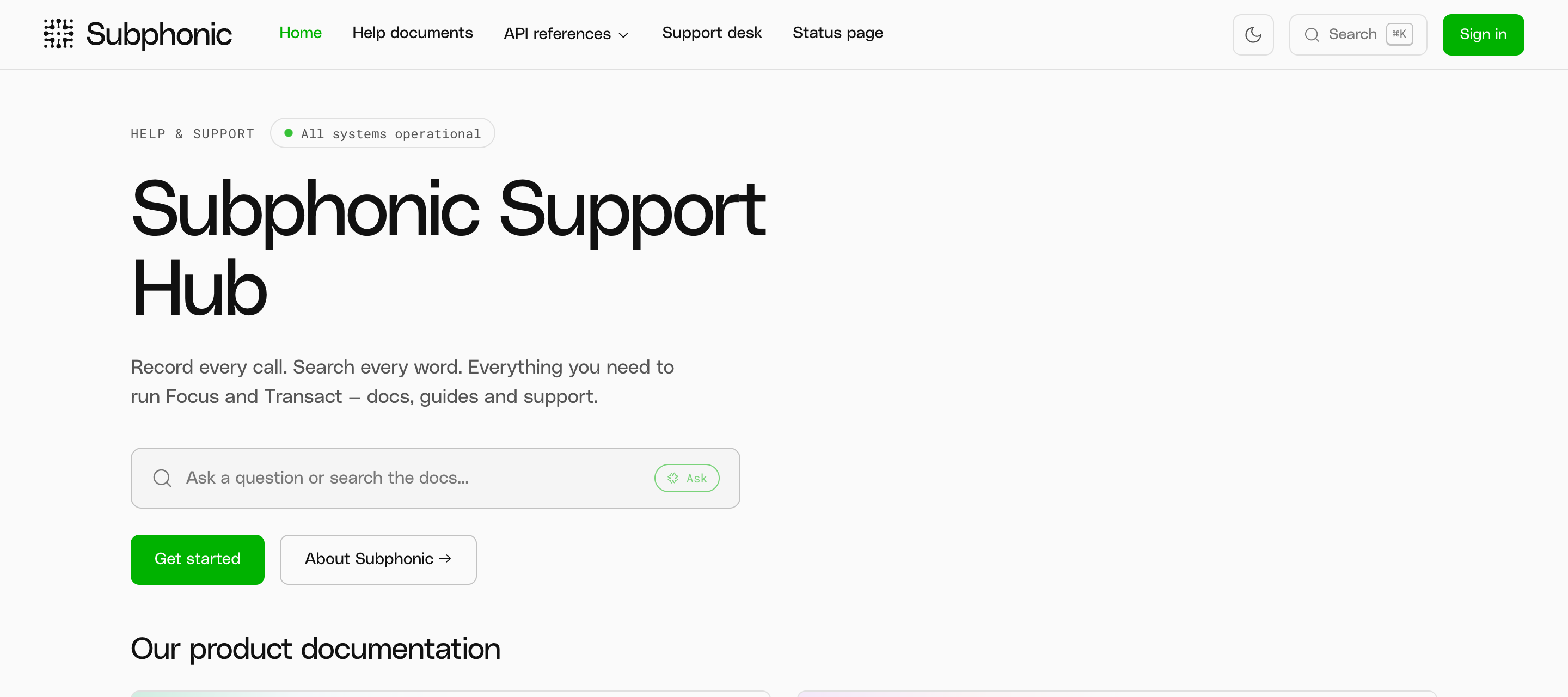
- Ask box - Type a question and get an answer from these documents. See Ask the assistant.
- Platform status - A live pill showing the current health of the platform. Click it for the full status page.
- Navigation - The same bar on every page: help documents, API references, the support desk and the status page.
- Sign in - Signs you in to the support desk to log and track tickets.
🤖 Ask the assistant
The fastest route to an answer is usually the Ask box on the Hub home page. Type a question the way you would ask a colleague — "how do I add a new user to Focus?" — and press Ask.
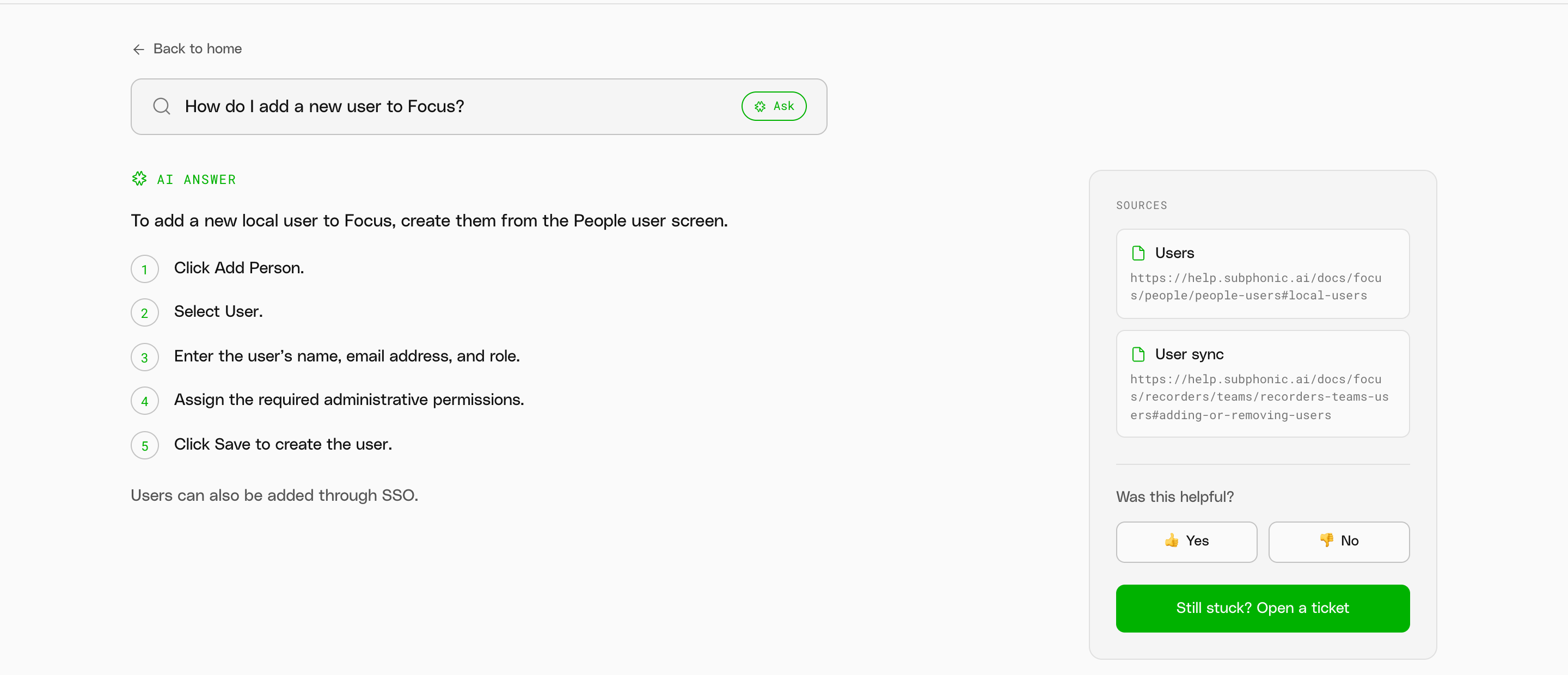
- The answer - A short, direct answer, with numbered steps where there are steps.
- Sources - Every answer lists the documentation pages it was drawn from. Click through to read the detail.
- Was this helpful? - Tell us. This is how we find the gaps in these documents.
- Still stuck? Open a ticket - Straight from the answer to the support desk, with no retyping.
The assistant only answers from this documentation. If the docs don't cover your question it will say so rather than guess — that is the point at which to log a ticket.
📈 Platform status page
The status page is public and always available, so it is the right first stop when something looks wrong. Our automated monitoring usually spots a problem before anyone has to report it.
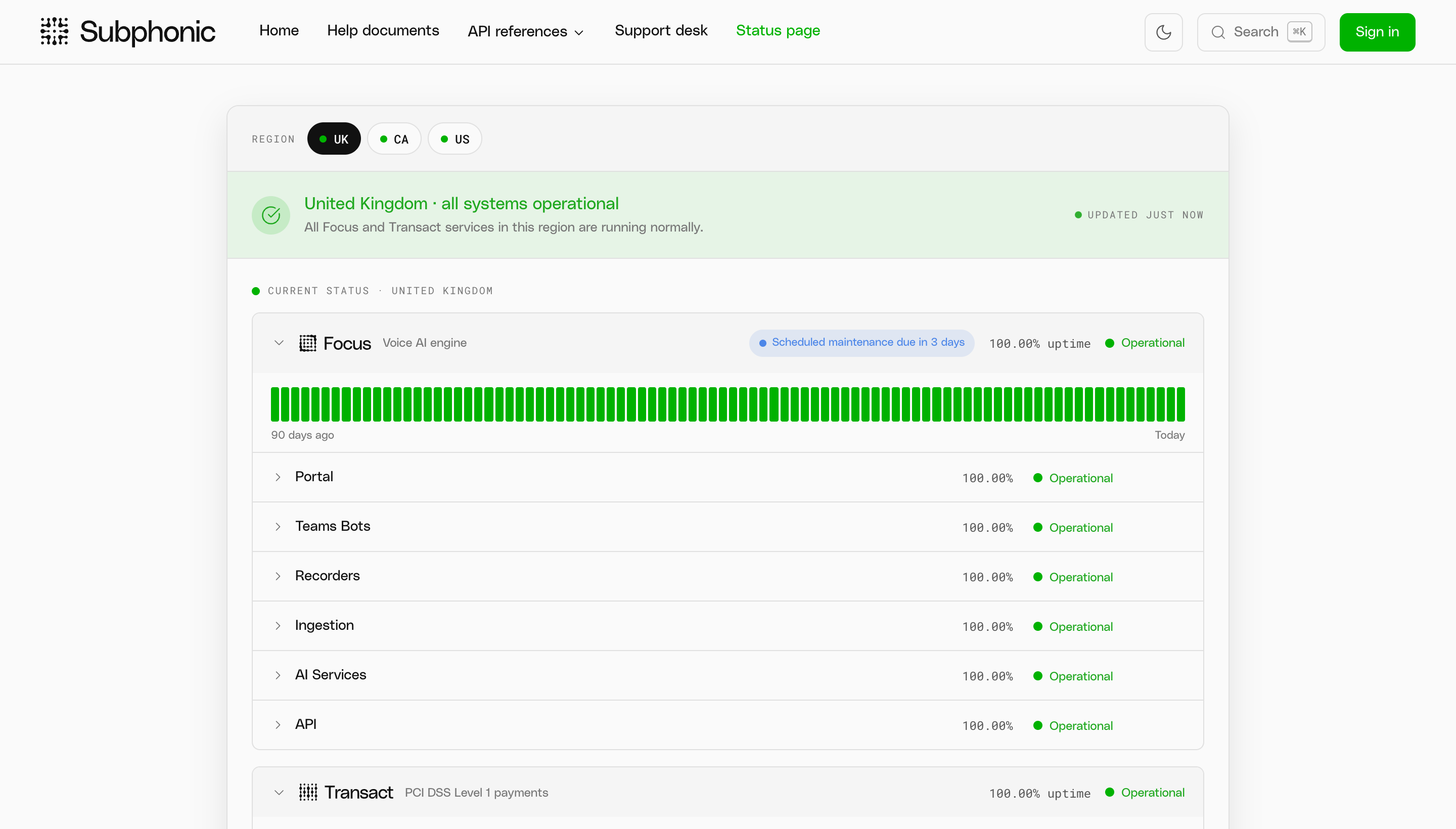
- Region - Health is reported per region. Pick the region your service runs in.
- Overall health - One line telling you whether everything in that region is operating normally.
- Products and services - Focus and Transact each show an overall state, 90 days of history, and every service beneath them. Click a service to see its own 90-day record.
- Uptime - The rolling 90-day figure for that product or service.
What the states mean
| State | What it means |
|---|---|
| 💚 Operational | We are not aware of any issue. If something looks wrong to you anyway, please log a ticket. |
| 🔵 Under maintenance | Planned work is in progress. See Scheduled maintenance. |
| 🟠 Degraded performance | Working, but slower or less resilient than normal. |
| 🔴 Major outage | Not working for most users, with no workaround yet. |
Scheduled maintenance
Maintenance is a normal part of running a platform. We keep to a regular pattern and book emergency windows only when we have to.
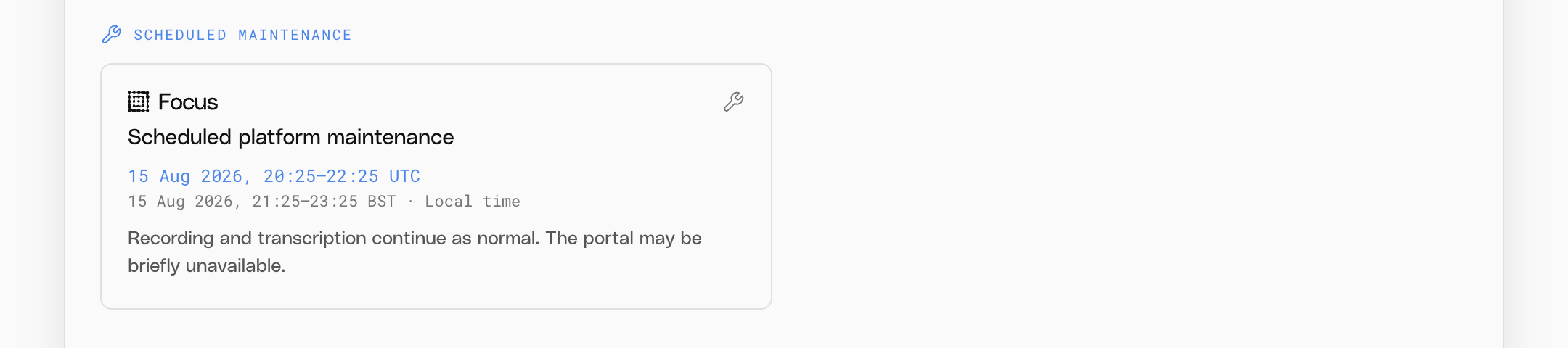
Any upcoming window shows the product it affects, the window itself in UTC and in your own local time, and what impact to expect. A chip appears on the product as the window approaches — "due in 3 days", then "due today", then "currently happening" — so you are not caught out.
Incidents and history
An open incident appears at the top of the page with a running set of updates: what we know, what we are doing, and when we last looked at it. Below the products, the page keeps a day-by-day record so you can check whether that odd five minutes last Tuesday was you or us.
Once an incident is resolved the team follows our ISO 27001 process and produces an incident report. Complicated incidents can take a few days to write up properly — if you need an answer sooner, ask on your ticket.
🥷 Support desk
Got a question, not sure how to complete a task, think you have spotted an issue, or just need help finding something? Log a ticket and our Customer Ops Ninjas will be on it. 🚀
Signing in
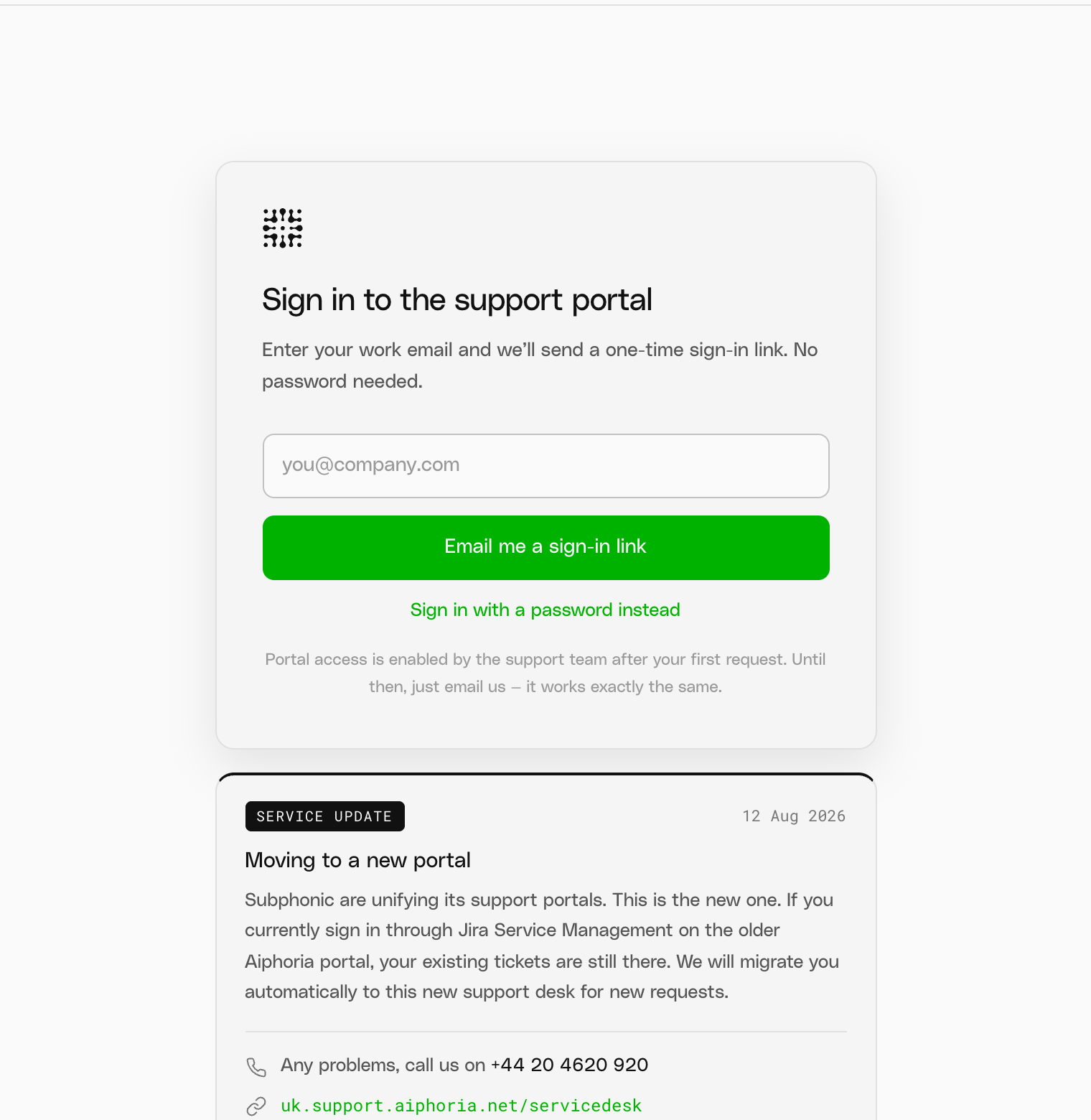
Enter your work email and we send you a one-time sign-in link — no password to remember or reset. The link expires shortly and works once.
If you would rather use a password, choose Sign in with a password instead. Password sign-in requires two-factor authentication, which you can set up from your account menu once you are in.
Portal access is enabled by the support team after your first request. Until then, just email us — it works exactly the same, and your emails become tickets automatically. Subphonic staff cannot grant access to unknown users: during onboarding you gave us the people who should have it, and anyone in that group can request more.
Your tickets
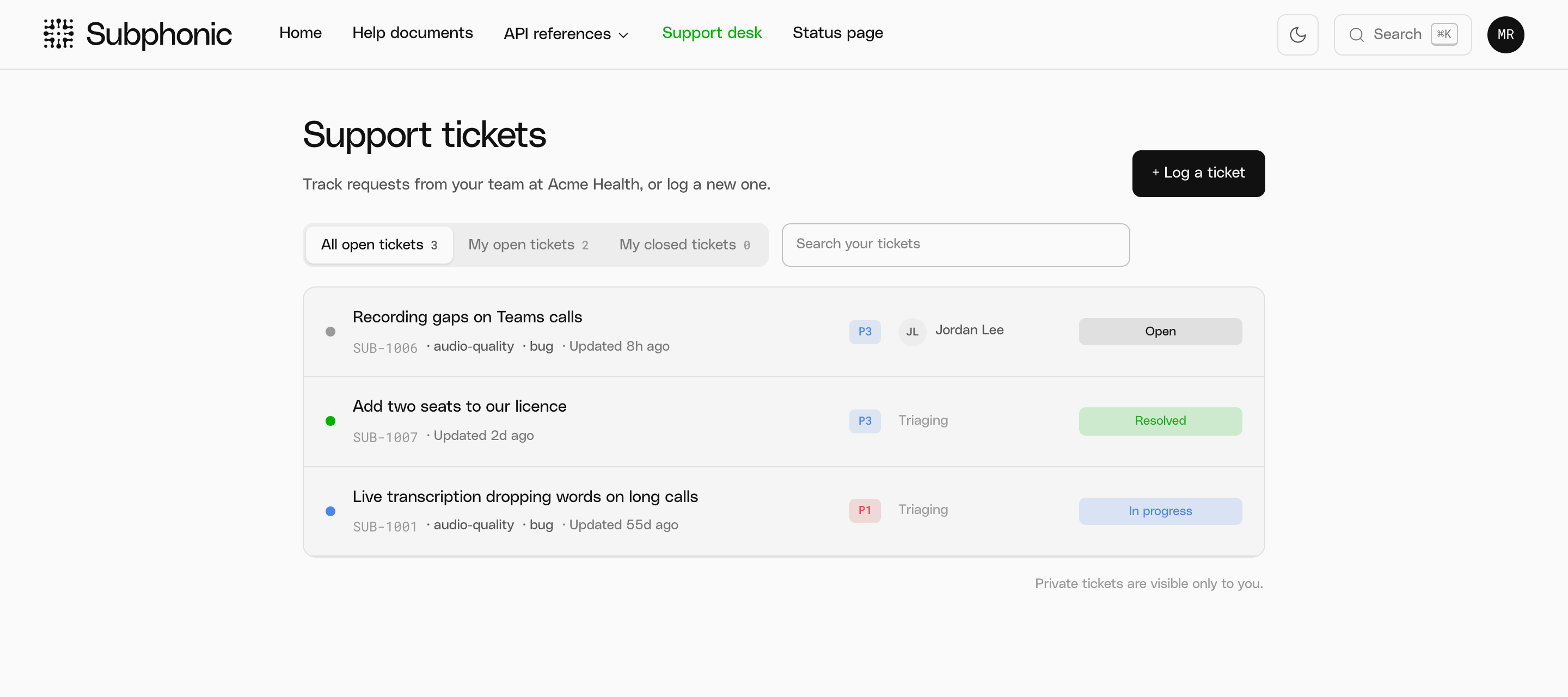
- All open tickets - Everything still open across your organisation, so you can see what a colleague has already raised before logging a duplicate.
- My open tickets - Just the ones you raised.
- My closed tickets - Everything of yours closed in the last 90 days.
- Search - Search by subject or ticket reference.
- Log a ticket - Start a new request.
Each row shows the reference (quote this if you call us), the priority, who has it, and its current state.
What the statuses mean
| Status | What it means |
|---|---|
| New | Logged and waiting to be picked up. |
| Open | An engineer has it and is working on it. |
| Awaiting your reply | We have asked you something and are waiting to hear back. The clock is paused while it sits here. |
| Awaiting 3rd line reply | With our engineering team for deeper investigation. |
| In progress | Actively being worked on. |
| Resolved | We think it is fixed. Reply if it is not — that reopens it. |
| Closed | Finished. A reply to a closed ticket starts a fresh one, linked to the old. |
Logging a ticket
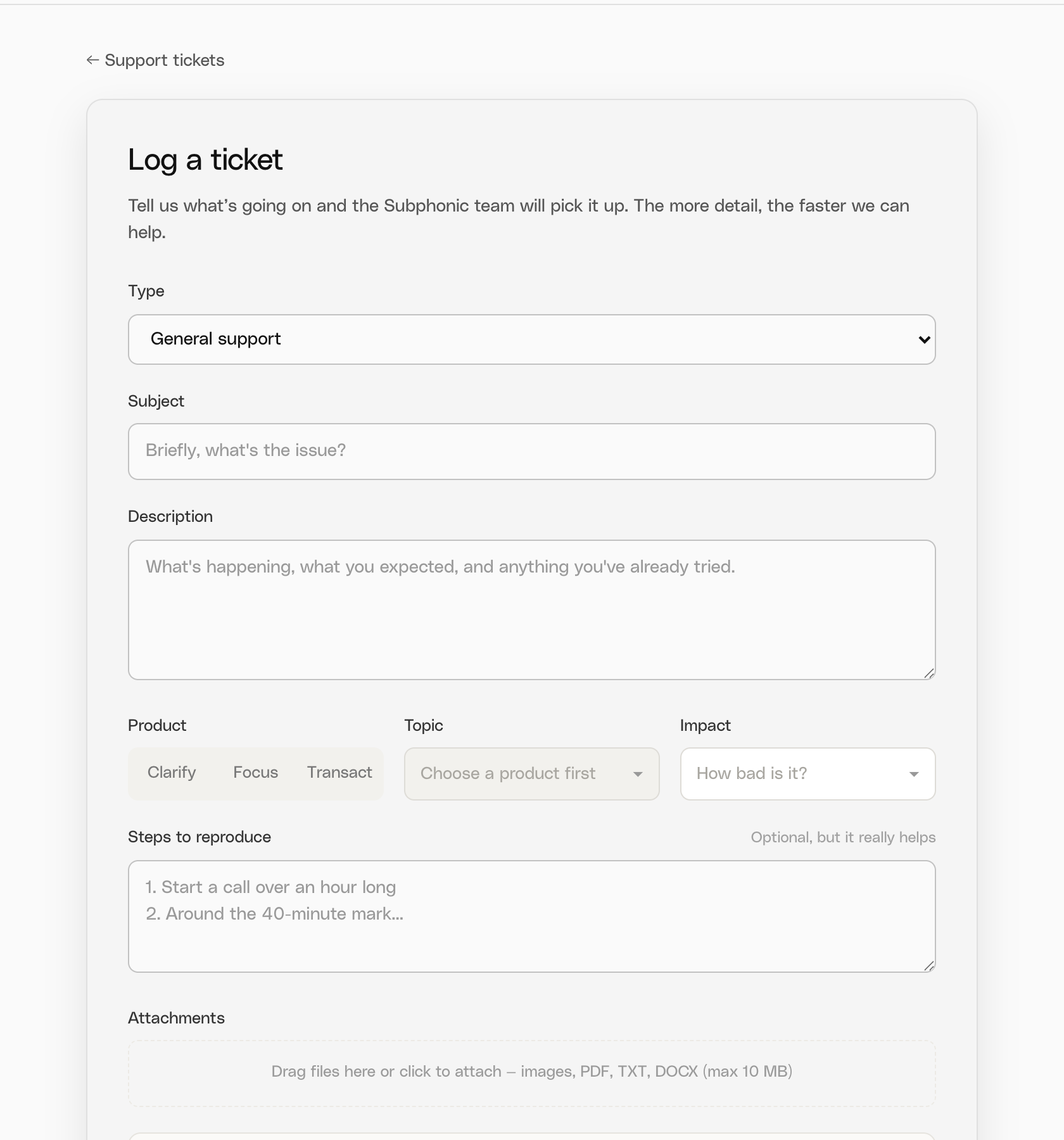
The more you can tell us up front, the fewer rounds of questions before someone is actually fixing it.
- ✔️ Product - Which product the problem is in. Only the products your organisation holds are listed.
- ✔️ Topic - What the request is about. The list changes to match the product you picked.
- ✔️ Summary - A clear title. "New Teams endpoints not showing in portal" is good. "Everything is broken" is... less helpful.
- ✔️ Impact - How badly this is hurting you. See Impact levels.
- ✔️ Description - What happened, when, what the error said, and who hit it. If you can include the URL the user was on, even better.
- ✔️ Attachments - A screenshot is worth a thousand tickets. Drag files in or browse for them.
- ✔️ Private - By default your colleagues can see the ticket, which avoids duplicates. Switch it to private if the contents are sensitive.
Impact levels
Impact sets the priority the ticket is worked at, so pick the line that matches what your users are actually seeing.
| Impact | Use this when… |
|---|---|
| P1 — Blocking | No users can work at all — a full production issue. |
| P2 — High | A major feature is no longer working for some or all users. |
| P3 — Medium | A small issue affecting only some users or workflows, or one you have a workaround for. |
| P4 — Low | A minor issue, something cosmetic, or just a question. |
The Subphonic team may re-categorise the impact based on the rest of the information in the ticket, or against other tickets and known issues.
Following a ticket
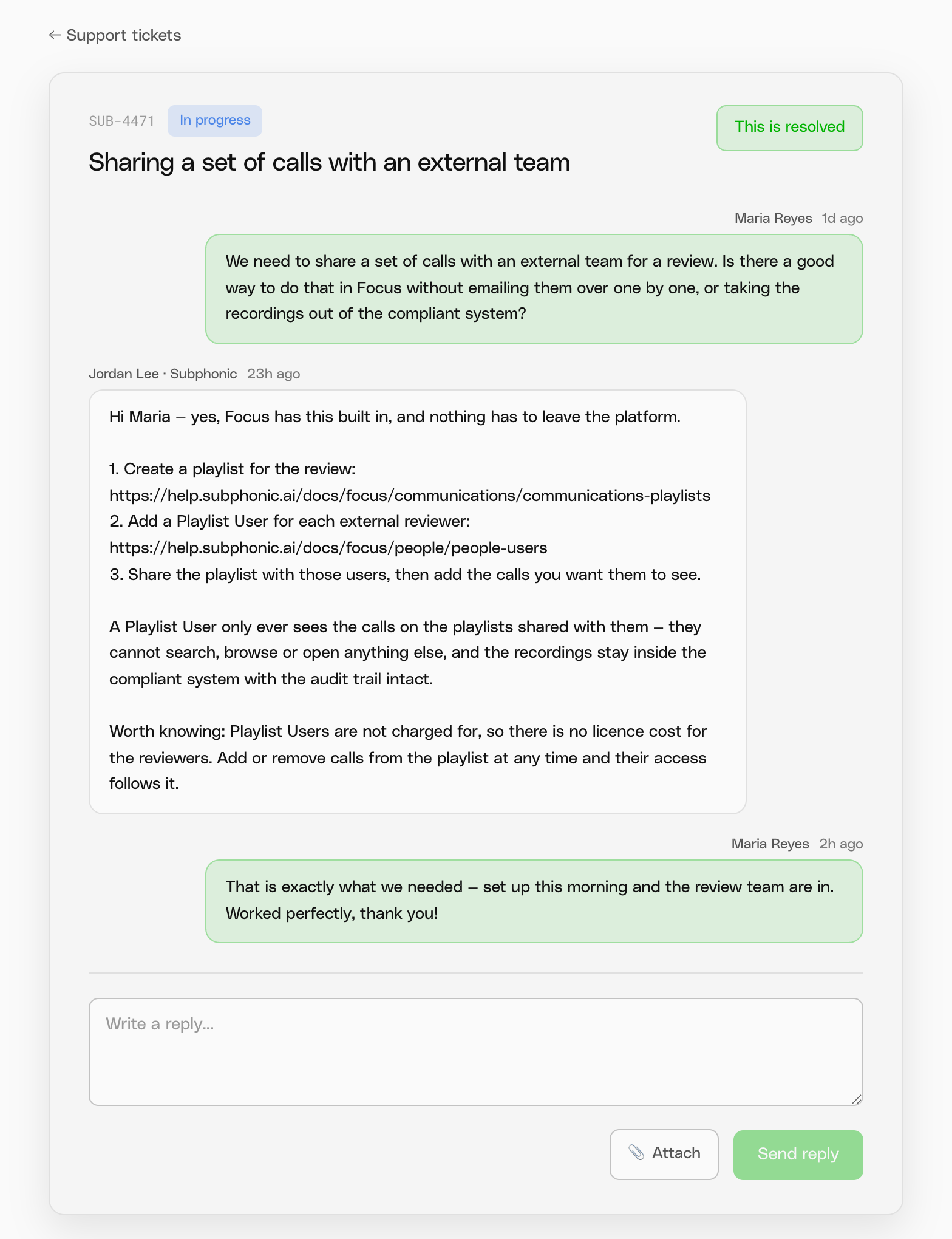
Everything about a request lives in one thread — yours and ours, in order, with any files attached along the way.
- Reference and status - The ticket number and where it has got to. Quote the reference if you call us.
- The conversation - Every reply from you, your colleagues and our team, newest last.
- This is resolved - Close it yourself when you are happy. You do not need to wait for us.
- Reply - Add information or answer a question. Replying to a ticket that is waiting on you puts it straight back in our queue.
Every notification we send can simply be replied to — your reply lands on the ticket, attachments and all. You never have to sign in to keep a conversation going.
Need help logging a ticket?
If logging a support ticket is itself the problem… don't worry. Email servicedesk@subphonic.ai or call +44 20 4620 920 and we will sort it out for you.
Happy ticketing! 🎫💻🚀
Escalation
You should never need this, but if you believe a ticket needs escalating, ask in the ticket itself: reply with the word "Escalation" and the reason. The ticket then follows our escalation workflow. If it is urgent, or you would rather talk it through, call +44 20 4620 920.
Tickets escalate automatically if an SLA target is missed — you do not have to chase for that to happen.